
patent Filing Process

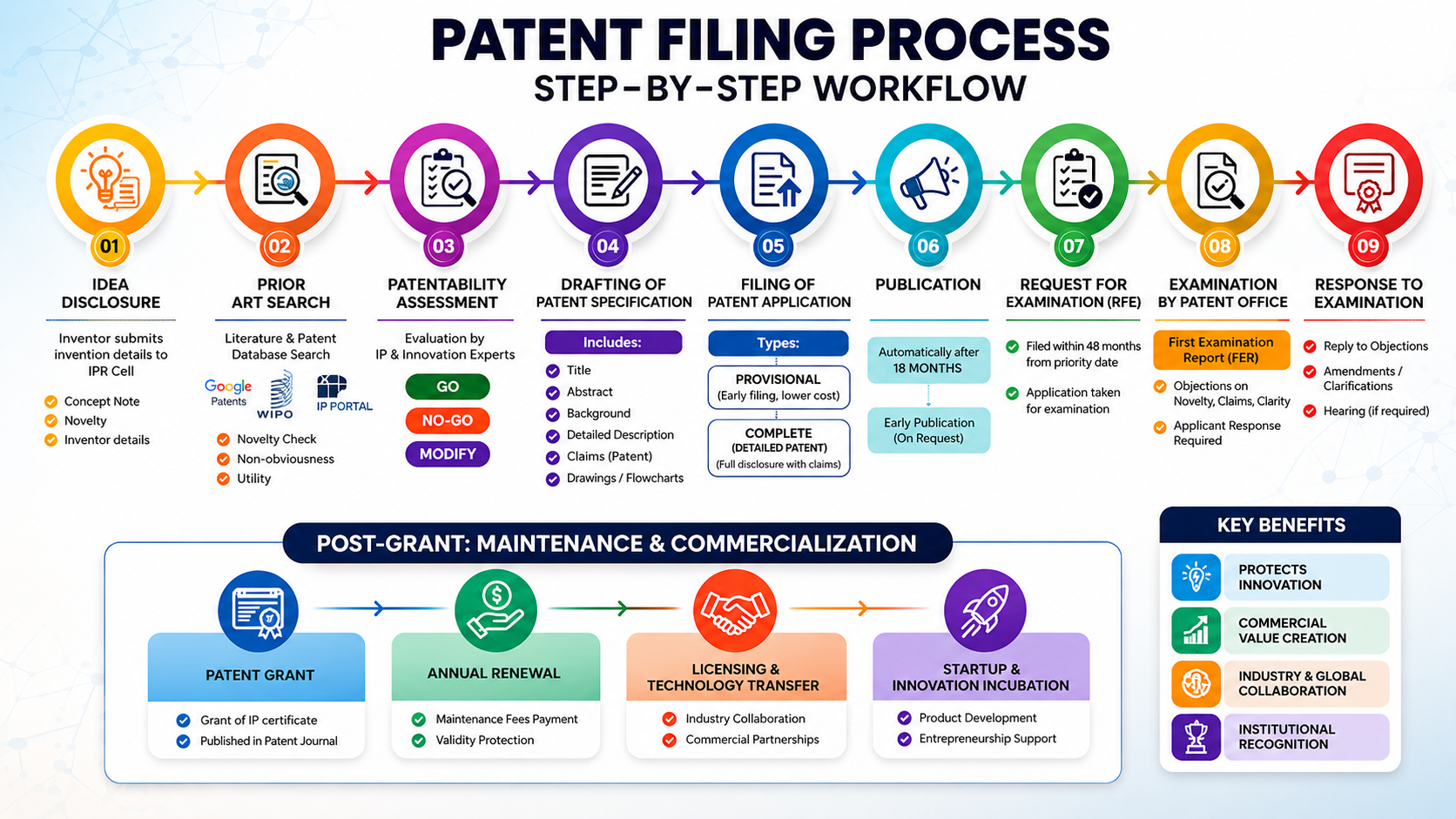
01 – IDEA DISCLOSURE
Innovator submits invention details to IPR Cell
- Concept Note
- Novelty
- Inventor Details
The process begins with idea disclosure, where innovators submit details of their invention to the IPR Cell. Important information such as concept note, novelty, and inventor details are documented. This stage helps establish ownership, evaluate originality, and initiate further review for patentability assessment and intellectual property protection support.
02 - PRIOR ART SEARCH
Literature & Patent Database Search
- Google Patents
- WIPO
- IP India
- Novelty Check
- Non-Obviousness
- Utility
A detailed literature and patent database search is conducted using platforms like Google Patents, WIPO, and IP India. The invention is checked for novelty, non-obviousness, and utility. This step helps identify existing related technologies and determines whether the proposed invention qualifies for patent filing and intellectual property protection.
03 – PATENTABILITY ASSESSMENT
Evaluation by IPR Committee / Experts
- GO
- NO-GO
- MODIFY
The invention is evaluated by the IPR Committee and subject experts to assess its patentability, innovation value, and practical applicability. Based on the review, recommendations such as GO, NO-GO, or MODIFY are provided. This process ensures only eligible and strong inventions move forward for patent drafting and filing procedures.
04 – DRAFTING OF PATENT SPECIFICATION
Includes
- Title
- Abstract
- Background
- Detailed Description
- Claims (Critical)
- Drawings / Flowcharts
Patent drafting involves preparing a comprehensive specification including title, abstract, background, detailed description, claims, and drawings or flowcharts. Claims are critical as they define the legal scope of protection. Proper drafting strengthens the patent application and improves clarity, technical accuracy, and the chances of successful patent grant approval.
05 – FILING OF PATENT APPLICATION
Types
- PROVISIONAL (Early filing, less disclosure)
- COMPLETE SPECIFICATION (Full disclosure with claims)
The patent application may be filed as a provisional application for early priority with limited disclosure or as a complete specification containing full technical details and claims. Filing establishes the official priority date and initiates the legal patent process, providing inventors with protection for their innovative ideas and technologies.
06 – PUBLICATION
Includes
- Automatically after 18 MONTHS
- Early Publication (On Request)
The patent application is automatically published after eighteen months from the priority date unless early publication is requested by the applicant. Publication makes the invention publicly accessible while preserving the applicant’s rights. This stage increases transparency and enables the application to proceed further toward examination and potential patent grant approval.
07 – REQUEST FOR EXAMINATION (RFE)
File within 48 months from priority date
Application taken for Examination
The Request for Examination must be filed within forty-eight months from the priority date for the patent application to be examined. Once submitted, the patent office begins detailed technical and legal evaluation of the invention. This mandatory step is essential for progressing toward examination, approval, and eventual patent grant.
08 – EXAMINATION BY PATENT OFFICE
First Examination Report (FER)
- Objections on: Novelty, Claims, Clarity
- Applicant Response Required
During examination, the patent office issues the First Examination Report containing objections related to novelty, claims, clarity, or legal compliance. The applicant must provide appropriate responses, clarifications, or amendments. This process ensures the invention satisfies patentability requirements and strengthens the application before final consideration for patent approval and protection.
09 – RESPONSE TO EXAMINATION
- Reply to Objections
- Amendments / Clarifications
- Hearing (if required)
Applicants respond to objections raised during examination by submitting replies, amendments, or clarifications to the patent office. Additional hearings may also be conducted if necessary. Proper response handling improves the quality of the application, resolves examination concerns, and supports successful progression toward final patent grant and legal protection.
POST-GRANT: MAINTENANCE & COMMERCIALIZATION
PATENT GRANT
- Granted if all criteria met
- Published in Patent Journal
A patent is granted once all examination requirements and legal criteria are successfully fulfilled. After approval, the granted patent is officially published in the Patent Journal. This provides the inventor with exclusive rights and legal protection, preventing unauthorized use, manufacturing, or commercialization of the patented invention by others.
ANNUAL RENEWAL
- Maintenance Fees Payment
- Validity Protection
Patents require annual renewal through maintenance fee payments to keep legal protection active throughout the validity period. Timely renewal safeguards ownership rights and prevents the patent from lapsing. This process ensures continued protection of the invention and preserves the exclusive commercial rights granted to the patent holder.
LICENSING & TECHNOLOGY TRANSFER
- Industry Collaboration
- Commercial Partnerships
Licensing and technology transfer promote commercialization of patented inventions through industry collaboration and commercial partnerships. Patent owners can authorize companies to use the technology under agreed terms. This process encourages practical application of innovations, generates revenue opportunities, and strengthens connections between academic research and industrial development sectors.
STARTUP & INNOVATION INCUBATION
- Product Development
- Entrepreneurship Support
Startup and innovation incubation activities support innovators in product development, entrepreneurship, and commercialization of new technologies. Guidance, mentoring, and networking opportunities help transform innovative ideas into sustainable ventures. This initiative encourages innovation-driven growth, startup culture, and the successful conversion of research outcomes into impactful real-world solutions.
KEY BENEFITS
- * PROTECTS INNOVATION
- COMMERCIAL VALUE CREATION
- INDUSTRY & GLOBAL COLLABORATION
- INSTITUTIONAL RECOGNITION
The patent filing process protects innovation by securing intellectual property rights and preventing unauthorized use. It creates commercial value through licensing and partnerships while encouraging industry and global collaboration. Institutional recognition is enhanced through research achievements, innovation culture, and successful commercialization, strengthening the organization’s reputation in academics and technology development.
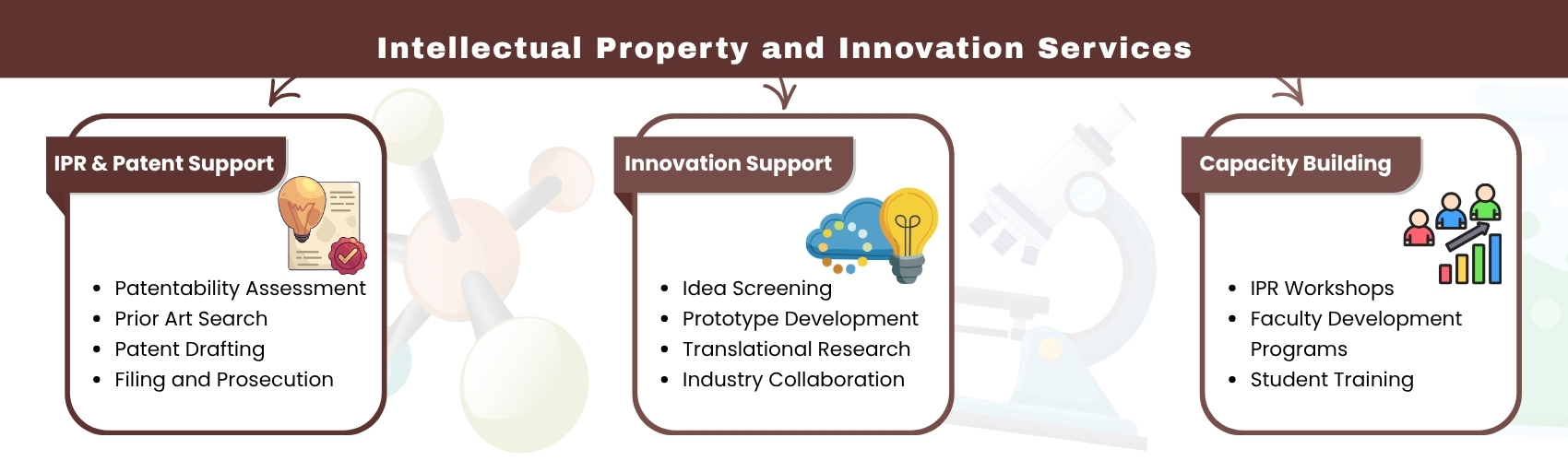
The Intellectual Property and Innovation Services (IPRIC) at SBDCH promotes innovation, research, and intellectual property protection among students, faculty, and researchers. The center provides guidance for patent filing, innovation development, research support, and industry collaboration to transform ideas into impactful solutions.
IPR & Patent Support
- Patentability Assessment
- Prior Art Search
- Patent Drafting
- Filing and Prosecution
IPRIC supports innovators throughout the patent filing process, from idea evaluation to successful filing and examination.
Innovation Support
- Idea Screening
- Prototype Development
- Translational Research
- Industry Collaboration
The center encourages innovative thinking and helps convert research ideas into practical applications and technologies.
Capacity Building
- IPR Workshops
- Faculty Development Programs
- Student Training
IPRIC conducts awareness programs and training sessions to strengthen knowledge in intellectual property, research, and innovation.
Quick Links
- About
- Contact
- Facilities
- Feedback
- NIRF
- Campus Life
- Excellence
- NAD Registration
- Alumni
- Alumni Feedback Mechanism
Quick Links
- MOrth RCPS
- ISDR 2026
- Oral Cancer Awareness
- World No Tobacco 2026
- World No Tobacco 2025
- Madras Icon 2026
- World Hypertension Month
- Annual Report
- Newsletter
- Sitemap
COLLEGES
- Bharath Institute of Higher Education and Research
- Sree Balaji Medical College and Hospital
- Sri Lakshmi Narayana Institute of Medical Sciences
- Sree Balaji College of Nursing
- Sree Balaji College of Physiotherapy
- JR Medical College and Hospital
Contact Us
Sree Balaji Dental College & Hospital,
Velachery Main Road,
Narayanapuram, Pallikaranai,
Chennai - 600 100. Tamilnadu, India
sbdchcprincipaloffice@gmail.com
College Office Number: 044- 22461883
Out-Patient Enquiry Number: +91 73051 22279
BDS/MDS Degree Admission Helpline: +91 96777 17858